Symptoms about the same
Continue with the planned referral
- If your symptoms stay much the same, continue with the planned referral and follow any advice your GP has already given you.

Compass Surgical
This guide is here to help you understand your hernia and feel prepared for the next steps. Take it at your own pace, and share it with anyone supporting you. Your surgeon will help you explore the options and decide what is right for you.
Start here
Read this guide in your preferred language
English is the source guide. Choose an available translated version below.
Choose a language to read this guide.
Text size
Choose a comfortable reading size
Narration
Listen to this guide
Professional audio is available section by section and for the full guide.
Natural professional narration only. The guide will not switch to a robotic device voice.
Where are you now?
Tap the stage that best matches where you are. The whole guide remains available.
Chapter 1 · Referral from your GP
Your GP thinks you may have a hernia and would like a specialist opinion.
The consultation will help confirm what is causing your symptoms, how much it is affecting you, and whether watching it or considering repair makes most sense for you.
Important information
You do not need to decide about treatment before your specialist appointment.
Your referral moves through three simple steps.
Step 1
Your GP sends information that is relevant to this referral, such as your symptoms, medical history and any useful test or scan results.
Step 2
The specialist team reviews the referral. If more information is needed, Compass Surgical will contact your GP.
Step 3
Compass Surgical will contact you within 2 working days of receiving the referral. This confirms the referral has arrived and tells you the next step. Your actual specialist appointment may be later.
Your GP practice remains your usual point of contact for your ongoing care while you wait. Once Compass Surgical receives the referral, its team is responsible for reviewing it and contacting you about your specialist appointment.
If you have not heard from Compass Surgical within 2 working days, contact your GP practice so they can check that the referral was received and is progressing.
This is an extra safety check. It does not transfer responsibility for following up the referral to you.
If your GP practice is closed and you need advice that cannot wait, use your usual after-hours service. If symptoms are severe or rapidly worsening, seek urgent medical care.
Most people simply continue with the planned referral. Here is what to do if things change while you are waiting.
Symptoms about the same
Something is changing
Something urgent happens
Chapter 2 · Before your consultation
Saved only on this device. Loupa does not verify these dates. Your appointment letter and booking instructions remain the source of truth.
To prepare for your specialist consultation, select what matters to you, choose some questions you want to discuss, or add your own question. You can type it or use the microphone to dictate it.
What matters to me
Select anything that matters to you.
Discuss with your healthcare team
Save any that would help you understand your own situation.
Saved on this device. Nothing is sent automatically. If you choose to email your questions from My questions, your own email app will open a draft for you to review and send.
Important information
You do not need to decide about treatment before your consultation.
Bring the questions and priorities you have saved. Your surgeon will assess your hernia and discuss the options with you.

Explore the guide
Start with the short referral and preparation section before your first specialist appointment. Detailed information about diagnosis, treatment, risks and recovery comes after the specialist consultation.
Chapter 03 · Understanding the problem
A hernia happens when tissue pushes through a weak point or opening in the abdominal wall. Its position, symptoms and effect on your life help guide what happens next.
Hernias are usually named according to where the weakness occurs. The location and type of hernia can influence the symptoms you experience and the treatment options available.
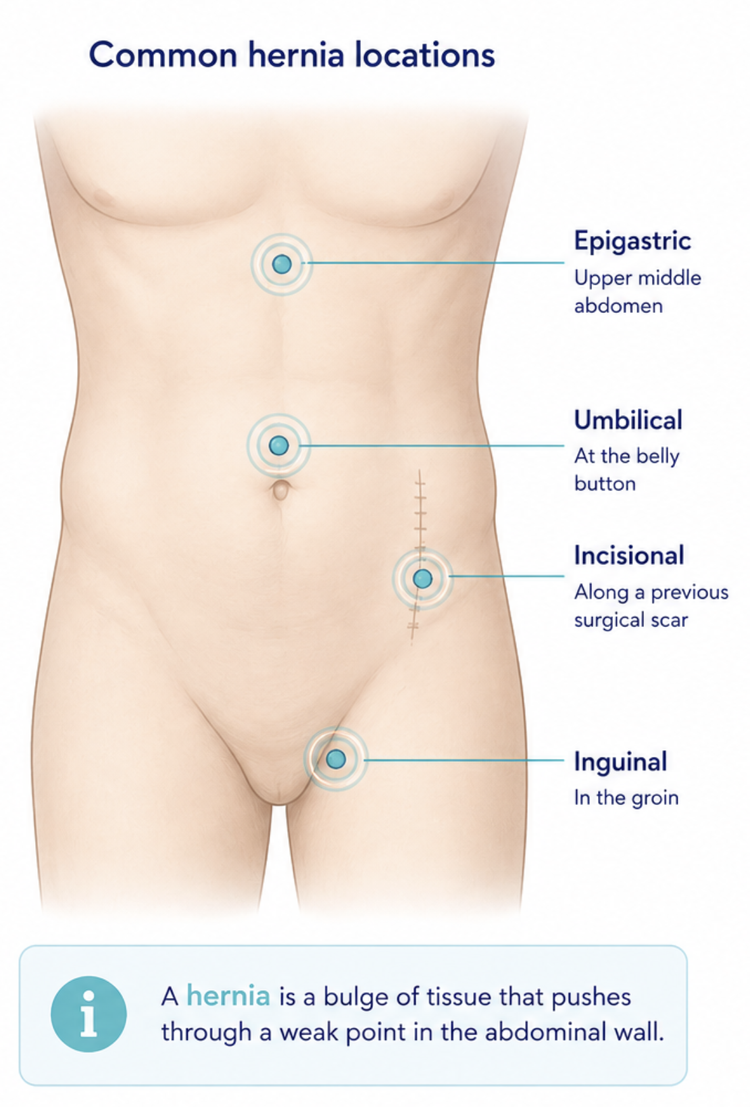
Hernias affect people differently. Some cause very little trouble, while others cause symptoms that interfere with work, exercise or everyday activities.
A visible or noticeable lump
Aching or discomfort around the hernia
Symptoms during lifting, coughing or exercise
A feeling of pressure, pulling or heaviness
A lump that becomes more noticeable when standing or later in the day
A reducible hernia is one where the contents of the hernia can move back through the opening in the abdominal wall, either by themselves or with gentle pressure.
A hernia may therefore be obvious when you are standing and much less noticeable when you lie down.
Many groin and abdominal wall hernias can be diagnosed from your symptoms and examination.
Your surgeon may examine the area while you are standing and may ask you to cough or strain gently so the hernia becomes easier to assess.
A scan is sometimes useful when the diagnosis is uncertain or when more information about the abdominal wall is needed, but not every hernia requires imaging.
Where the hernia is and what type it is
How long you have noticed it
Whether it is getting larger or changing
Whether it causes pain or limits your activities
Whether the lump goes back in when you lie down
Seek urgent help
A hernia that suddenly becomes very painful, firm, increasingly swollen or no longer goes back in needs prompt medical assessment, particularly if you also develop vomiting, worsening abdominal pain or feel unwell.
If you develop severe or rapidly worsening symptoms, seek urgent medical care rather than waiting for a routine appointment.
Important information
Your surgeon will assess the type of hernia you have and, importantly, how much it is affecting you. This helps guide the decision about whether treatment is worthwhile.
Not necessarily. The next chapter looks at when observation may be reasonable and when treatment becomes more worthwhile.
Discuss with your healthcare team
Save any that would help you understand your own situation.
Saved on this device. Nothing is sent automatically. If you choose to email your questions from My questions, your own email app will open a draft for you to review and send.
Chapter 04 · Deciding what to do
Not every hernia needs an operation. The decision is usually between watching it and considering repair, based on your symptoms, the hernia itself and what matters to you.
Important information
The main question is whether repairing your hernia is likely to improve things enough for you to justify an operation, its risks and the recovery afterwards.
For many people, observation is not the same as doing nothing. It can be an active and appropriate management plan.
Option 1
This may be reasonable when the hernia causes few symptoms and is not significantly interfering with everyday life.
Option 2
Surgery may become more worthwhile when the hernia is causing troublesome symptoms or restricting what you want or need to do.
The size of the lump alone is not usually the most important issue. What often matters more is how the hernia behaves and how much it affects you.
Pain, aching, pressure or pulling that appears to come from the hernia
Difficulty working, exercising, lifting or doing normal activities
A hernia becoming larger or increasingly troublesome
Increasing difficulty reducing or pushing the hernia back in
The type, position and clinical features of the hernia
A hernia may be visible on examination or a scan without being the main cause of groin or abdominal-wall pain. Surgery is less likely to improve symptoms if those symptoms are coming from something else.
Part of your consultation is therefore working out whether the hernia is actually responsible for the problem you want treated.
Your age, fitness, other medical conditions, previous operations, medications, work, activities and personal priorities can all influence whether the likely benefit of surgery outweighs its downsides.
There is no single answer that applies to every person with a hernia. It can help to think about what you may gain from repair and what surgery asks of you in return.
Possible benefits
Things to weigh up
The useful question is: Is the expected benefit of repair worthwhile enough to you to justify surgery, its risks and the recovery afterwards?
Hernias can be repaired in different ways. The best approach depends on the type of hernia, previous surgery, your health and your surgeon's assessment.
Approach 1
The hernia is repaired through an incision close to the hernia itself.
Approach 2
The repair is performed through several smaller incisions using a camera and surgical instruments.
Neither approach is automatically best for everyone. Your surgeon will recommend an approach based on your particular hernia and circumstances.
Mesh is commonly used in adult hernia repair. It reinforces the weakened area and is intended to reduce the chance of the hernia returning.
A non-mesh repair may be appropriate in selected situations. The decision depends on the type of hernia, the tissues being repaired and your individual circumstances.
You do not need to choose the technique by yourself.
If you have concerns about mesh, open surgery, keyhole surgery or any particular technique, bring them to your consultation so the options can be discussed properly.
Although the exact technique varies, a hernia repair usually involves identifying the defect, returning any protruding tissue to the correct position and strengthening the weak area.
Mesh, when used, is positioned to reinforce the repair. The location of the mesh and the position of the incisions depend on whether an open or keyhole approach is used.
Anaesthetic options also vary according to the operation and your individual circumstances. These details can be discussed with your surgeon and anaesthetist before surgery.
Keep an eye on how the hernia behaves and arrange review if it becomes more painful, larger, more difficult to reduce or starts to interfere more with everyday life.
This is not a test. Choose the answer that best reflects the main message of this chapter.
Quick check
Choose the answer that makes the most sense to you.
This is a self-check only. Your answer is not saved or sent anywhere.
Important information
Your surgeon will help you decide whether watching the hernia or repairing it makes more sense for you, and which type of repair would be appropriate if you choose surgery.
Discuss with your healthcare team
Save any that would help you understand your own situation.
Saved on this device. Nothing is sent automatically. If you choose to email your questions from My questions, your own email app will open a draft for you to review and send.
If surgery is being considered, the next step is to understand its possible complications and how those risks apply to you.
Chapter 05 · Making an informed decision
Most people recover well after hernia surgery, but complications can occur. Understanding the important risks helps you weigh surgery against your other options.
Important information
Published figures describe groups of patients. Your own risk depends on the type of hernia, the operation being considered, your health and whether the repair is straightforward or complex.
Pain, tenderness, bruising and some swelling around the operation site are common during early recovery and do not necessarily mean that something has gone wrong.
These usually improve as healing progresses. Chapter 6 explains recovery and the warning signs that should prompt further advice.
The exact risks vary between different types of hernia repair, but the following are among the issues commonly discussed.
Important risks
10–12
in 100
A proportion of people develop ongoing groin pain or discomfort lasting beyond the expected recovery period and affecting normal activities.
Bruising is common. Less often, a collection of blood can develop around the operation site and form a haematoma.
Fluid can collect where the hernia used to be and create a temporary lump or swelling. This often settles without treatment.
The likelihood varies considerably with the size and type of hernia and the repair performed.
A surgical wound can become infected. Increasing redness, heat, discharge, worsening pain or feeling unwell should be assessed.
Infection involving implanted mesh is uncommon but can be more difficult to treat.
Some people have temporary difficulty passing urine after surgery and anaesthesia and may need treatment before going home.
Repair reduces the weakness in the abdominal wall, but no operation can guarantee that a hernia will never recur.
Recurrence risk varies with the type of hernia, repair technique and individual factors.
Mesh is widely used in adult hernia surgery. Uncommonly, problems can occur such as infection, persistent pain or other complications involving the implant.
Depending on the hernia, nearby structures can include nerves, blood vessels, bowel, bladder and structures within the groin. Injury is uncommon but recognised.
What does “10 in 100” mean?
Imagine 100 people having similar surgery. If a problem occurs in 10 in 100 people, around 10 might experience it and around 90 would not.
These figures describe groups of patients rather than predicting exactly what will happen to you.
Yes. As with other operations, complications can include reactions to medicines or anaesthesia, breathing or heart problems and blood clots.
How relevant these are depends strongly on your age, medical history and general health.
The type, size and complexity of the hernia
Whether this is a first repair or a recurrent hernia
Previous operations in the same area
Your general health and other medical conditions
Smoking and other factors that can affect healing
The surgical approach being considered
Important information
“Are any of these risks particularly important for me?”
The aim is not to find a risk-free option. It is to understand whether the likely benefits of repair outweigh its risks and recovery for you.
This is not a test. Choose the answer that best reflects what you have just read.
Quick check
Choose the answer that makes the most sense to you.
This is a self-check only. Your answer is not saved or sent anywhere.
Discuss with your healthcare team
Save any that would help you understand your own situation.
Saved on this device. Nothing is sent automatically. If you choose to email your questions from My questions, your own email app will open a draft for you to review and send.
Good consent is more than signing a form. You should have the opportunity to understand the information relevant to you and discuss anything that remains unclear.
Why surgery is being considered
The expected benefits and important risks
Reasonable alternatives, including waiting where appropriate
The opportunity to ask questions and have them answered
The opportunity to make your own decision once sufficiently informed
For most elective hernia surgery, there is time to consider the recommendation and ask further questions before deciding.
NZ Code of Health and Disability Services Consumers’ Rights
https://www.hdc.org.nz/your-rights/about-the-code/code-of-health-and-disability-services-consumers-rights/
Chapter 06 · If you decide on surgery
Saved only on this device. Loupa does not verify these dates. Your appointment letter and booking instructions remain the source of truth.
This part of the guide is for you if you and your surgeon have decided to proceed with an operation. Your booking information will contain the instructions specific to you.
Important information
Your hospital and anaesthetic instructions take priority over general information in this guide because your arrival time, fasting and medication plan may be individual to you.
Tick these off as you get organised. Your progress stays on this device.
Your preparation checklist
You’re ready when all items are ticked.
You have checked the main practical arrangements. Keep your booking information handy in case anything changes.
Your fasting instructions will be included with your booking or confirmed by the hospital or anaesthetic team.
Follow those instructions rather than calculating your own fasting time from this guide.
If you accidentally eat or drink outside those instructions, tell the hospital team. Your operation may need to be delayed for safety.
Do not stop regular medicines simply because you are having surgery. Some need specific instructions before an operation.
Blood-thinning medicines
Insulin and other diabetes medicines
GLP-1 diabetes or weight-loss medicines
Make sure the hospital or anaesthetic team knows what you take. If you are unsure, check with them rather than stopping or changing a medicine yourself.
The hospital may contact you to confirm your arrival time, medication instructions or other practical details.
Keep your phone available and check any messages you receive.
Check in
The hospital team confirms your details and prepares you for the operation.
Meet the clinical team
You are reviewed by the surgical and anaesthetic teams before surgery.
Confirm the plan
Your identity, operation, consent and important clinical information are checked before theatre.
It is still fine to ask questions on the day.
If something about the operation, alternatives, risks or recovery is still unclear, tell your team before proceeding.

When it is time for your operation, the theatre and anaesthetic teams take over your care. The photograph below shows the type of operating theatre environment you may encounter.
Before surgery begins, the team completes the usual safety checks and confirms your identity, the planned operation and the important information relevant to your care.
Your anaesthetic team looks after you throughout the procedure, while your surgical team performs the hernia repair that has been discussed with you.
The anaesthetic plan is tailored to you.
Keyhole hernia surgery requires a general anaesthetic. Open repair is also commonly performed under general anaesthesia, although other anaesthetic approaches may sometimes be suitable.
The anaesthetic team will discuss the plan with you before surgery and monitor you throughout the operation.
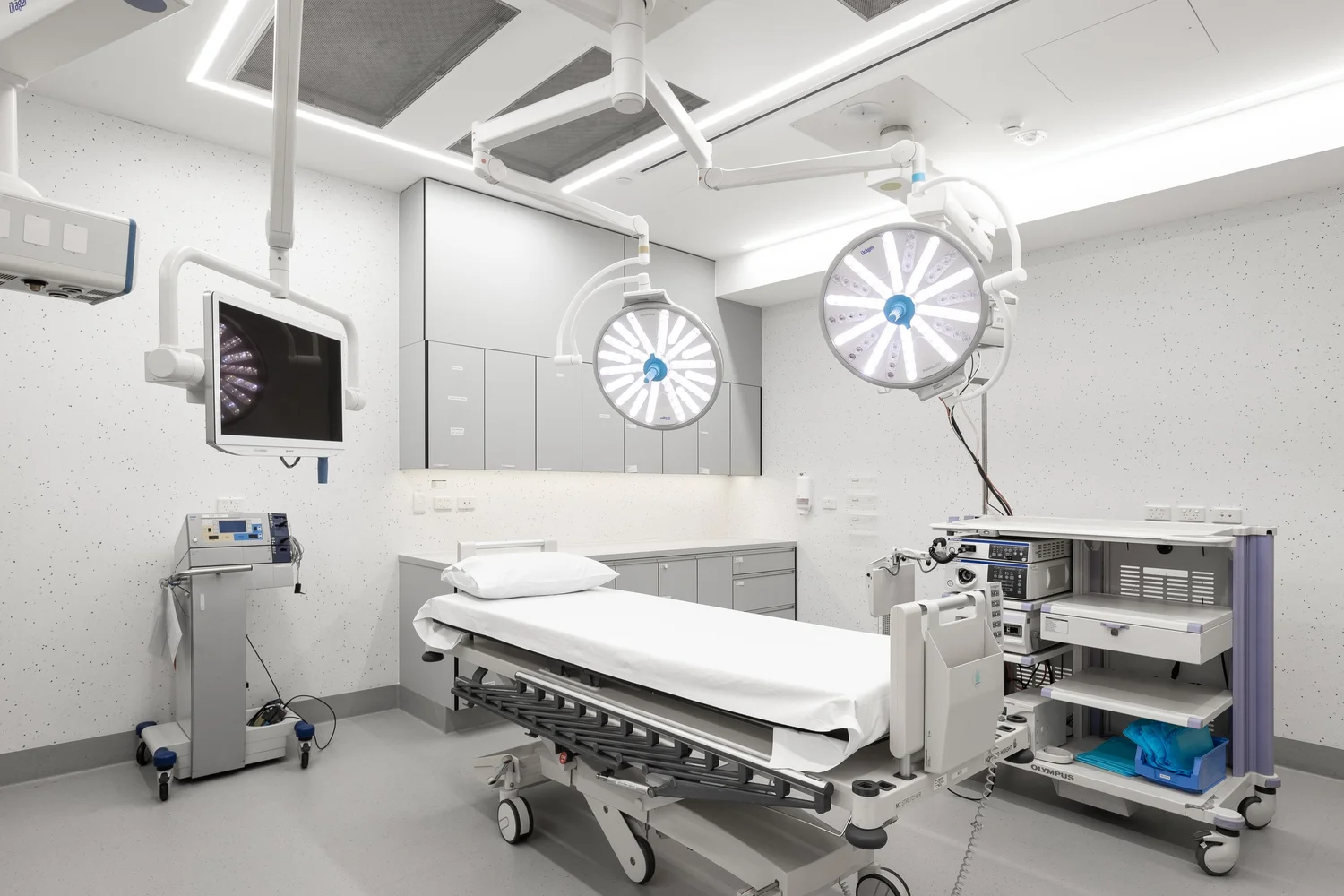
The exact operation depends on the type of hernia and the approach being used, but the underlying principles are similar.
The hernia is identified
The defect and the tissues involved are identified.
The tissues are returned
Tissue pushing through the hernia is returned to the correct side of the abdominal wall.
The weak area is repaired
The abdominal wall is repaired and, where appropriate, reinforced with mesh using the technique planned for you.
The wounds are closed
The incision or keyhole wounds are closed and dressings are applied as needed.
If mesh is used
Mesh is positioned to cover and reinforce the weak area rather than simply filling the opening. In most standard mesh repairs, it is intended to remain in place permanently.
When the operation is finished, you are taken to the recovery area. The nursing and anaesthetic teams stay with you as you wake and make sure your immediate recovery is progressing safely.
A recovery nurse will monitor you as you wake from the anaesthetic and make sure your immediate recovery is progressing safely.
You may feel sleepy at first. The team will check your observations, comfort and wounds, and treat pain or nausea if needed.
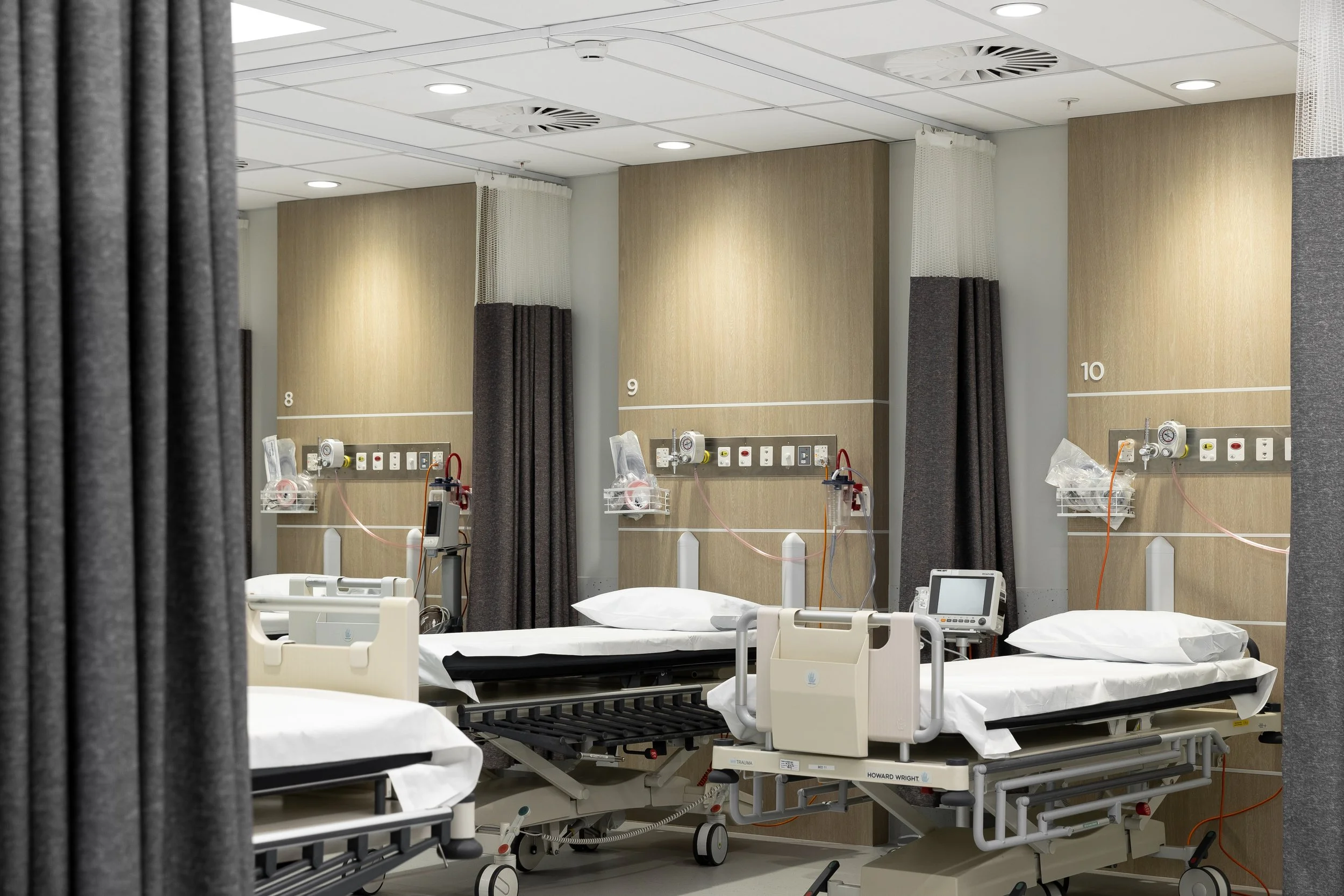
The wounds and repaired area will usually feel sore after the operation.
Anaesthetic medicines and surgery can leave you feeling sleepy or tired for a while.
Some people feel sick after anaesthesia. Medication can be given if this happens.
When it is safe, the team will help you sit up, move around and begin preparing for discharge.
The hospital team will make sure you have recovered sufficiently from the operation and anaesthetic before you are discharged.
Your immediate recovery is satisfactory
Your pain and nausea are manageable
You can move around safely
Any other discharge requirements for your operation have been met

Once you are comfortable and the clinical team is happy with your recovery, you may move to a discharge area while your final instructions, transport and other arrangements are completed.
Discuss with your healthcare team
Save any that would help you understand your own situation.
Saved on this device. Nothing is sent automatically. If you choose to email your questions from My questions, your own email app will open a draft for you to review and send.
Chapter 07 · Once you are home
Saved only on this device. Loupa does not verify these dates. Your appointment letter and booking instructions remain the source of truth.
Recovery is different for everyone. The aim is to keep you comfortable, stay mobile and gradually return to the activities that matter to you.
Important information
Some discomfort, swelling and tiredness are expected at first. As these improve, gradually increase what you do according to how you feel and the instructions you were given at discharge.
You may have less energy than usual and the operated area will usually feel sore, particularly when you move, cough or change position.
Take the pain relief recommended in your discharge instructions and keep gently mobile. You do not usually need to stay in bed.
The wounds and repaired area can feel uncomfortable, especially with movement.
Bruising around the wound or groin may become more noticeable before gradually settling.
Some swelling around the operation site is common during early healing.
It is common to have less energy than usual for a while after surgery.
Recovery care
Use the pain relief recommended when you leave hospital. Keeping discomfort controlled can make it easier to move, sleep and gradually return to normal activity.
Follow the wound and dressing instructions given to you at discharge. Check the wounds as they heal and seek advice if you are concerned about how they look or feel.
No. Rest when you need to, but try to get up and move around regularly rather than spending long periods in bed.
Start with short walks and normal gentle activities, then increase what you do as your comfort and confidence improve.
There is not one recovery timetable that suits everyone. Your operation, your work and how you feel all influence how quickly you return to normal activities.
Gentle walking can usually begin straight away and is an important part of recovery.
Increase exercise progressively. More strenuous exercise and heavier lifting should be guided by your comfort, the type of repair you have had and any specific advice from your surgical team.
If an activity causes significant pain, reduce the intensity and build back up more gradually.
When you return to work depends partly on what your job involves. Someone doing desk-based work may return earlier than someone whose job involves repeated lifting or heavy physical activity.
Discuss any particular work requirements with your surgeon, especially if you need guidance about lifting or restricted duties.
Do not drive while the effects of anaesthesia or sedating pain medicines could impair you.
Before driving again, you should be comfortable enough to enter and leave the vehicle, wear the seatbelt and control the vehicle safely, including making an emergency stop.
Check any specific instructions from your surgical team and your insurer if you are uncertain.
Help after surgery
If recovery is not going as expected, choose the route below that best matches the problem.
If your question is not urgent and you would rather write it down, email the Compass Surgical team. Your email app will open so you can review the message before sending.
Email your questionsEmergency
Call 111 if symptoms are severe or rapidly worsening, you feel seriously unwell, or you think it is an emergency. Do not wait for an email reply or routine callback.
Call 111Follow-up is usually arranged after surgery, often at around six weeks, although the timing may vary depending on your operation and recovery.
Contact the team earlier if you are concerned rather than waiting for a planned appointment.
Discuss with your healthcare team
Save any that would help you understand your own situation.
Saved on this device. Nothing is sent automatically. If you choose to email your questions from My questions, your own email app will open a draft for you to review and send.
The important things are understanding the main choices, knowing what matters to you and knowing where to find help if you need it.
Clinical governance Reviewed and approved by Compass Surgical This patient guide has been clinically reviewed and approved for use by Compass Surgical. Clinical author Dr Thomas Hanna Consultant General Surgeon, Compass Surgical Final clinical review Dr Peter Swan Consultant General Surgeon, Compass Surgical Status Approved Approved for Compass Surgical patient use Clinical review August 2026 Next formal review August 2027, or earlier if relevant evidence, guidance or local practice changes About this guide This guide supports, but does not replace, discussion with your surgeon or other healthcare professionals. Recommendations need to be applied to your individual hernia, symptoms, health and circumstances. If information given directly to you by your surgeon, anaesthetist or hospital differs from general information in this guide, follow the instructions given specifically for your care. Evidence, review and quality assurance The guide has been developed from established surgical practice, relevant clinical guidance and published evidence, together with the local care pathway used by Compass Surgical. Numerical estimates are presented as approximate population-level figures where useful. Individual risk may be higher or lower and should be discussed with your surgeon. Patient-facing wording, information structure and interactive elements have been designed to support understanding, consultation preparation and shared decision-making. The guide should be reviewed earlier than the scheduled review date if important new evidence, safety information, clinical guidance or local care processes change. Privacy and saved information This guide is not a medical record or patient portal. Questions, priorities, checklist progress and other information you save while using the guide are stored locally in your browser on this device. They are not automatically sent to Compass Surgical or Loupa and do not become part of your clinical record unless you choose to show or discuss them with your healthcare team. Clearing your browser data may remove information you have saved within the guide. © 2026 Loupa Ltd · Patient guide provided by Compass Surgical. Copyright & use Original patient education content, information design, software, interactive components and patient pathway architecture are copyright Loupa Ltd. Compass Surgical is licensed to provide this guide to its patients. Patients may view, save, print or share the guide for their own personal healthcare use. Reproduction, adaptation, commercial reuse, republication or deployment of the content, design, software or pathway architecture by another organisation requires permission from Loupa Ltd.
About this guide
This guide provides general information to help you prepare, understand the information relevant to your care, save questions and return to the information after your consultation.
It supports, but does not replace, individual discussion with your healthcare team.
Recommendations may differ according to your symptoms, test results, medical history and individual circumstances.
Guide information
See something that needs updating?
Contact Compass Surgical.